Our mission is to enhance the profession of research management and administration, and to facilitate excellence in research through identifying, establishing and exchanging good practice in research management and administration.
We work to deliver our mission by:
- Delivering training and development events
- Providing information, advice and support through regular newsletters, communications and guidance materials
- Facilitating networking for the exchange of best practice and for mutual support amongst members
- Promoting strategic partnerships within and around the sector
- Facilitating one-to-one mentoring and providing financial support for individual professional development
- Representing the collective view of UK research managers and administrators through engagement with government, industry, charities and third sector organisations, and policy makers and influencers
- Raising the profile of research management and administration as a profession.
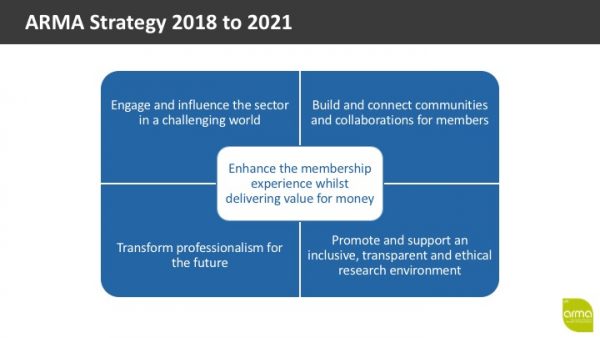
By now, we’re familiar with the scenarios that the polls failed to predict, both here and across the Atlantic. Outcomes of both the EU referendum and US elections have spawned policies that are at odds with the higher education principles of diversity, collaboration, and academic excellence. We are on the road to leaving the European Union, with little understanding of how this will impact our research funding, or the movement and right to work of foreign nationals. Against this background, the Higher Education and Research Bill has been enacted, receiving Royal Assent in April 2017. The Act includes the creation of a new body – UK Research and Innovation (UKRI) – that will be the ‘strategic centre of the UK’s research and innovation funding system’, and Research England, designed to ‘oversee the England-only functions in relation to research and knowledge exchange’. At the same time, we’re preparing for the next Research Excellence Framework, and work on a Knowledge Exchange Framework is underway. Both are likely to be affected by the new UK Industrial Strategy, published in late 2017.
This unstable political situation means that funding sources for research are, at best, uncertain. There are opportunities – not least, the Global Challenges Research Fund and the new Industrial Strategy Challenge Fund – but continued access to European Union assets has not been confirmed. The new funds will support capacity building in the UK and developing countries, and provide resources for university collaborations with industry and business, all with a focus on finding solutions to the world’s biggest problems. Success will be driven by effective networks, and the sharing of information and knowledge, both in the UK and overseas.
Building partnerships will be an essential factor in benefiting from these opportunities, just one part of the skillset that will be necessary for any successful research office. Transformations in technology, globalisation and demographics mean that the traditional roles of research administrators and managers are changing. More complex teams will be created, bringing together multiple disciplines and areas of expertise, much of which will be based outside of the research office and the institution. Technological advances will continue to affect the ways in which we work and communicate with others. And leadership skills – being able to act as an influencer, a translator, a learner and a teacher – will grow in importance across all career levels. We will work on further aligning our training & development programme, annual conference and qualifications with a refreshed professional development framework to reflect these changing requirements.
All of this is looking in towards our research activity. But we also need to look beyond our institutions, engaging the public and restoring their faith in the research that institutions deliver. Growing public trust in research will be essential in securing access to funding in the future, and – more importantly – to enable the research outputs to be translated into effective solutions to the challenges we face. This means putting an even greater emphasis on research integrity, being confident in our research data to evidence results, and conducting all our business in a more transparent way.
The review of governance in 2017 established a set of guiding principles against which to test decision making, activities, and commitments. These guiding principles our also underpin the Strategy for 2018.