We are pleased to announce the highly commended and winners of ARMA Awards. The 2025 recipients were revealed at the Awards Ceremony on Wednesday 18 June 2025 during the ARMA Conference gala dinner in the National Museum of Scotland.
Congratulations to all our awards recipients:
Advocacy in Research Management
Winner: Dr Elizabeth Gadd, Loughborough University
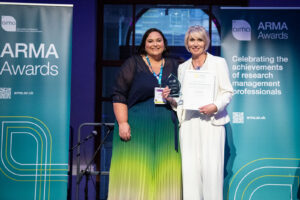
Dr Elizabeth Gadd is a deserving winner of the advocacy award, for her transformative work on research evaluation and assessment. As chair of the INORMS Research Evaluation Group, she guided the development of the SCOPE framework for responsible research evaluation, now used worldwide, and spearheaded the More Than Our Rank initiative, shifting the culture around HEI rankings. She has championed responsible evaluation practices as Vice-Chair of CoARA, champions responsible evaluation through leadership in ARMA’s Research Evaluation SIG, founded the LIS-Bibliometrics Forum/The Bibliomagician, while leading at Loughborough University. She has made a significant impact on national and international approaches to research assessment.
Innovation in Research Management
Highly Commended: Fraser Rowan, Lindsay Middleton and Neil McIntyre, University of Glasgow
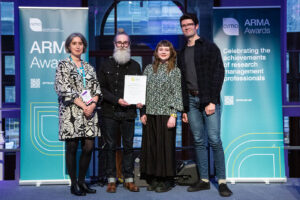 Fraser, Lindsay and Neil have conceptualised, developed, and grown Partnership Catalyst: a unique design-led knowledge exchange infrastructure that is able to transform the processes by which universities engage non-academic organisations to address regional and global challenges. Working in partnership with researchers at The Glasgow School of Art, the team has pioneered a combination of design methods with innovative KE practice-based research to overcome identified barriers to interdisciplinary and intersectoral collaboration. This approach is now recognised across the University as a highly effective way of tackling complex challenges and discovering, through co-creation, new solutions.
Winner: Evidence and Analysis Service led by Christopher Daley, London School of Economics and Political Science (LSE)
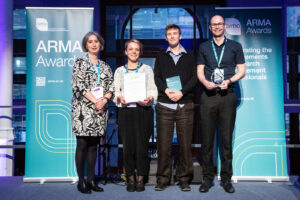 LSE’s Evidence and Analysis Service led by Christopher Daley, a pioneering initiative providing a robust evidence base for strategic research and innovation decisions, distinct from traditional policy compliance or REF functions. The service focuses on understanding LSE’s R&I ecosystem, monitoring the external landscape, maximizing the impact of internal funds, and leading responsive projects. It also leads a national community of practice in R&I evidence and analysis. This service ensures that the research office is a critical partner in strategic decision-making, demonstrating how research managers can be practitioner metascientists through comprehensive data analysis and reporting.
Research Culture in Research Management
Highly Commended: The Research Culture Enablers Network: National Centre for Research Culture, University of Warwick
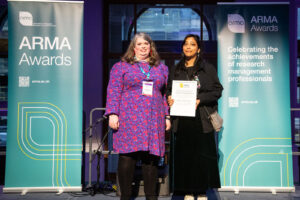 The Research Culture Enablers Network offers a platform for RMA colleagues to enhance research culture as a distinct specialism, providing space to improve practice and develop as thought leaders. It connects members with innovative initiatives and influential stakeholders, including funders, while showcasing grassroots projects and sharing what works and doesn’t work. By creating a trusted forum to test ideas, reduce duplication and build camaraderie in roles that are often stretched and have limited power, alone, RCEN inspires and has mobilised the community towards action, soon launching co created working groups to add value for everyone. Through podcasts, a national report with targeted recommendations to develop research culture professionals, and in person workshops, RCEN is empowering RMAs as actors of research culture change.
Winner: The Institute Culture Consultation (ICC), Babraham Institute
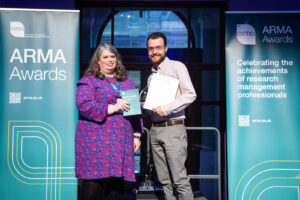 A comprehensive project to define and embed team science across the organisation. Through interviews, focus groups, online engagement and workshops, staff engaged with the ICC, identifying positive aspects and also challenges in the way of working, and prioritising areas for action. The project formalised the Institute’s definition of research culture and team science. Key outputs are a 4-year operational programme, the Roadmap for Team Science, organised around four themes: People, Communications, Technology, and Community). Tangible changes include improved recognition practices and a Staff Communication and Consultation Forum.
Research Management Team of the Year
Highly Commended: Research Development Team, University of Lincoln
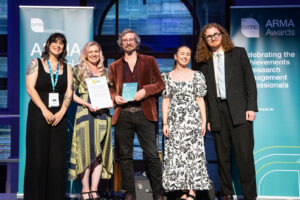 In a climate of significant financial pressure, where demand to secure external income has intensified but resources have been limited, the University of Lincoln’s Research Development Team has forged a fresh approach to pre-award research support, growing its research funding awards from £19.8M in 2022/23 to £40.2M in 2023/24. A team of only eight people, it delivers 600-800 research funding bids every year, influences the University’s strategic research direction, and raises the profile of the University regionally, nationally and internationally. Its achievements are a testament to its creativity, resilience and commitment to driving innovation in research development and management.
Winner: Research Compliance Team, University of Bristol
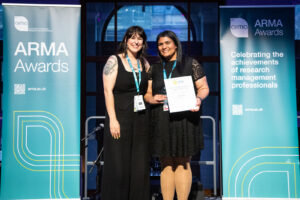 The Research Compliance Team is at the vanguard of a sector shift in research management of national security issues. Originally established in September 2021 with just one FTE, the team has evolved and grown to provide greater capacity to meet demand. Taking sector-leading positions in research security externally and providing a seamless, responsive and facilitative service internally using streamlined processes, effective data analysis systems, creation of project sub-teams, and detailed training provision for all stakeholders, the team is at the forefront of research management.