Lorna Wilson, outgoing Chair of ARMA
As I reflect on this year’s ARMA Conference, I am struck by two things.
The first is the extraordinary complexity of the environment in which research and innovation now operate. The second is the professionalism, resilience and expertise of the research management community that continues to navigate that complexity every day.
During our ARMA 2026 Conference opening plenary panel, we explored some of the biggest questions facing the sector. We discussed financial pressures, research security, international collaboration, the growing convergence of research and innovation, and the evolving role of the research professional. Alongside the panel discussion, we used Mentimeter to hear directly from delegates in the room. The responses painted a powerful picture of how colleagues across the sector are feeling.
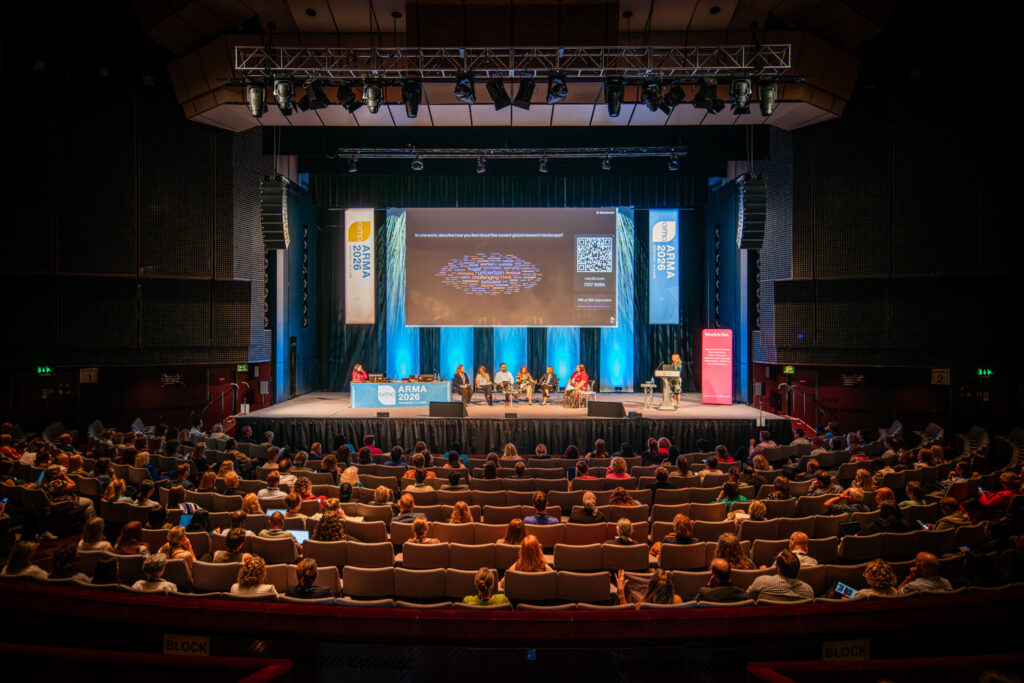
When asked to describe the current global research landscape in a single word, the most common responses were “uncertain”, “challenging”, “complex”, “turbulent” and “bleak”. Others spoke of feeling anxious, fragile, overwhelmed, pressured and concerned. Yet among those responses were also words such as opportunity, dynamic, innovative, resilient and potential.
That tension feels familiar. Across the UK and internationally, we are operating within a landscape that is simultaneously full of possibility and significant challenge. Research and innovation are increasingly recognised as drivers of economic growth, societal wellbeing and national prosperity. At the same time, institutions are managing financial constraints, geopolitical uncertainty, increasing regulatory requirements and rising expectations from governments, funders and partners.
Perhaps unsurprisingly, when asked whether they felt they were doing more with less, the overwhelming majority of delegates responded yes.
This is a reality that many of us recognise. Yet one of the strongest messages emerging from the panel was that research professionals are not simply responding to change. We are helping to shape how our institutions navigate it.
Too often, conversations about research focus on funding, policy or regulation, while overlooking the professional expertise required to translate those frameworks into successful outcomes. Research professionals sit at the intersection of strategy, governance, compliance, partnerships, culture, impact and delivery. We bring together people, knowledge and processes in ways that enable excellent research and innovation to happen.
This importance was reflected clearly in the discussion around Trusted Research and research security. While these requirements continue to evolve, relatively few colleagues reported feeling very confident in navigating them, and many highlighted the challenge of managing academic expectations alongside increasingly complex policy environments.
What stood out to me was that these challenges go far beyond routine administration. They are not about processing transactions or following set procedures; they require professional judgement, nuanced interpretation, relationship management, leadership and specialist expertise.
The same is true of the ongoing shift we discussed between research and innovation. Historically, these areas have often been viewed separately. Today, those boundaries are increasingly blurred as universities are expected not only to generate knowledge but also to maximise their societal, economic and cultural value. Yet delegates suggested that siloed working remains a reality in many environments, with most respondents indicating that research and innovation functions are still separated at least some of the time.
For me, this highlights another important aspect of our role. Research professionals are often the connectors within the system. We help bridge disciplines, functions, institutions, sectors and countries. We bring together researchers, funders, businesses, policymakers and communities. As the research ecosystem becomes more interconnected, this ability to connect people and perspectives becomes increasingly valuable.
What also struck me was the contrast between how delegates felt about the external environment and what they were most excited about at the conference.
While the landscape may be uncertain, the conference responses were overwhelmingly positive. The words that dominated the Mentimeter were learning, networking, connections, community, development, ideas, collaboration and support.
There is something important in that.
At a time when many colleagues are feeling stretched, the greatest source of optimism appears to be each other. The willingness of this community to share knowledge, exchange ideas, support peers and develop collectively remains one of the profession’s greatest strengths.
As I conclude my term as Chair of ARMA, that gives me enormous confidence for the future.
Research professionals have never been more important. The challenges facing research and innovation are unlikely to become simpler. The demands placed upon our institutions, our researchers and our systems will continue to evolve. But so too will our profession.
The future success of the UK’s world-leading research and knowledge exchange ecosystem will depend not only on investment, policy and infrastructure, but also on the expertise of the people who enable it.
Research professionals bring insight, judgement, leadership and innovation that add real value across the entire research lifecycle. We are not on the edge of the system. We are a vital part of it.
My hope is that we continue to demonstrate the confidence that our expertise deserves. That we continue to invest in our professional development, advocate for the value we bring, and support one another as a community. And that together we continue to build a research and innovation ecosystem that remains globally competitive, socially valuable and fit for the future.
If the conference reminded me of one thing, it is this: uncertainty may define the landscape, but professionalism, expertise and collaboration will define how we respond to it.
Grace McConnell, incoming Chair of ARMA
It was an honour to close ARMA 2026 as incoming Chair, and to have the opportunity to reflect on what had been a fantastic few days for our community.
It’s hard to focus my attention on just one session or achievement this year. We had fantastic keynote speakers, the ever-popular first-timers’ session, the always fabulous gala dinner and revamped Awards, and, importantly, the many formal and informal conversations in between.
The ARMA conference captures so much of what makes ARMA distinctive: our flourishing community, its generosity and professional pride, and a willingness to listen and learn from one another.
The sessions were inspiring and varied, but what stayed with me most was the sense of shared endeavour. Research managers and administrators came together not only to talk about challenges, but to exchange ideas, evidence, practical approaches and the confidence to try something new. I hope everyone who attended left with at least one idea to build on in their own institution before we meet again in 2027.
One of the strongest themes to emerge for me was the continuing maturity of research management as a profession. Last year, there was significant discussion about bureaucracy and the sometimes negative perceptions of research professionals. Those conversations were important, and they reflected real pressures felt across the sector.
But this year I sensed something different: a positive pushback against that perception. Not a denial of the pressures we face, but a growing confidence in the value, expertise and contribution of our profession.
For me, that is resilience.
The challenges facing our institutions and our sector are real. Financial sustainability, organisational transformation, the growing impact of trusted research, and rapidly developing technologies such as AI are already shaping the work we do.
This will require us to evolve and change in our profession, and that should not be designed and imposed in isolation. Change depends on trust: trust in the people delivering it, trust in the evidence they bring, and trust in the communities that understand how policy, practice and institutional realities connect.
ARMA is making a collective contribution to the wider research and innovation landscape. We are feeding into policy, shaping understanding, and bringing experience and evidence from practice into the spaces where decisions are made. As I transition into the role of Chair, I hope to build on the trust our members place in ARMA to advocate, engage and influence change on their behalf.
As incoming Chair, I am thinking a great deal about the year ahead for ARMA and for the profession. I am prioritising meeting new and familiar faces, and sharing my genuine belief that ARMA does not operate in a vacuum. We can provide greater value to our members and to the sector if we work in partnership with other professional bodies, sister associations and networks.
I am also considering ARMA’s unique value in helping members understand a changing policy landscape, which rarely seems to slow down long enough for us to take stock. I see ARMA having an important role in interpreting these changes through a research management lens, and in helping our members advocate for their expertise and integral role in ensuring the vitality of UK research.
I also want to recognise and thank Lorna for her phenomenal work as Chair. For many of us, Lorna has been a thread running through our ARMA experience. For me, she was there at one of the first conference sessions I attended, through her leadership as Research Development SIG Co-Chair. She went on to chair the Professional Development Committee as a Board Member, setting in motion much of the work we see today, including the professional development refresh.
As Chair, Lorna has renewed ARMA’s strategy and helped create a bold, inclusive and member-led culture. That contribution will continue to shape the association and the profession in the years ahead. I am looking forward to building on that work with our members as I begin my term as Chair.
If ARMA 2026 reminded us of anything, it is the value of coming together as a community. I encourage members to start planning for ARMA 2027 and look out for opportunities to get involved. Whether you are a long-standing member or attending for the first time, the conference remains one of the best opportunities to learn, connect and shape the future of our profession.