We are pleased to announce the highly commended and winners of the ARMA Awards. The 2026 recipients were revealed at the Awards Ceremony on Wednesday 17 June 2026 during the ARMA Conference gala dinner in the Harrogate Convention Centre.
Congratulations to all our awards recipients:
ARMA Volunteer of the Year
Winner: Dr Tania Cleaves, University of Nottingham
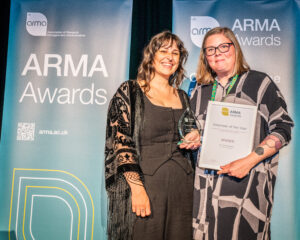
In the last two years, Dr Tania Cleaves has made a sustained and outstanding contribution to ARMA through several volunteering roles, working hard behind the scenes to champion arts and humanities research through mentoring roles, giving presentations at ARMA conferences, writing as an ‘alt-ac’ (alternative academic) in ARMA Insights and co-leading the Arts & Humanities Special Interest Group. Involved for years in both ARMA’s Mentoring Programme and ARMA’s partnership with AHRC and RLUK on its Research Catalyst Programme, she has devoted countless hours supporting others to thrive as researchers and research enablers.
Innovation in Research Management
Highly Commended: Dr Kanza Basit, University of Oxford

Kanza Basit structurally reimagined research management using AI tools. Starting with a single custom GPT to demystify the University’s John Fell Fund, she has built a suite of tools that now sits behind funding decisions, REF planning and impact case study development across the academic division. These AI systems turn dense guidance, past REF data and live information on who does what into clear, tailored answers, even for the tricky individual questions that normally take weeks to resolve, and have the potential to become a model for research management across the sector.
Winner: Carol Smee, Wellcome Sanger Institute

Carol Smee from the Research Governance team at the Wellcome Sanger Institute, is nominated for Innovation in Research Management for leading the development of the Ethical Framework for Obtaining Materials from Sentient Animals. This innovative Framework addresses a long-standing gap in ethical guidance for sourcing animal materials beyond regulated laboratory settings. Developed collaboratively through a national, cross-sector working group, and published openly via UKRIO, it provides a practical, replicable model for ethical due diligence. The Framework promotes animal welfare, equity of opportunity, reduces ethical and organisational reputational risk, enhances research quality, and has influenced research management practice nationally and internationally.
Research Culture in Research Management
Highly Commended: The Research Equity, Diversity and Inclusion (REDI) funding initiative, University of Leeds
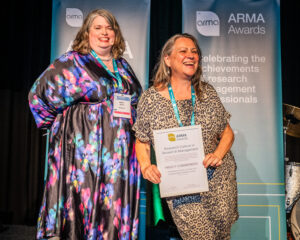
The Research Equity, Diversity and Inclusion (REDI) funding initiative, led by Soo Lincoln (Research Culture Advisor – Inclusion), is an innovative programme developed at the University of Leeds to address structural inequities in research careers. Embedded within the University’s Research Culture implementation plan, REDI uses positive action to improve equity of opportunity, research integrity and research quality. Delivered during a period of significant sectoral and geopolitical challenge, REDI demonstrates how research management can actively strengthen inclusive research cultures. By recognising systemic barriers such as time poverty, caring responsibilities and exclusion from networks, and through self‑defined funding and intersectional design, REDI reframes research culture as a collective responsibility and positions equity as foundational to sustainable research excellence.
Winner: Future Leaders Fellows Development Network
 Through comprehensive embedding of equality, diversity and inclusion in their strategy, the Future Leaders Fellows Development Network is enabling Fellows across the UK to impact and innovate in research culture. They deliver a sector-leading leadership development programme providing comprehensive resources that are designed with a clear understanding of Fellow needs and supported by UKRI. Their determination to share our resources, approaches and work in partnership with the wider sector, including institutions and support staff, reflects their intention to address inequalities in resourcing and enable smaller institutions to benefit from UKRI’s investment.
Collaboration in Research Management
Highly Commended: Joint Research Management Office (JRMO) Governance Section, Queen Mary University of London & Barts Health NHS Trust

The JRMO Governance Section at Queen Mary University of London and Barts Health NHS Trust has transformed research management through inclusive, collaborative innovation. Working as a single team across two organisations and nine sites, they streamlined study setup, improved data quality, and embedded equality, diversity, and inclusion in every process. Key achievements include an automated performance dashboard, harmonised procedures, and a pioneering approach to capturing patient demographics to widen participation. Their initiatives have reduced setup times, enhanced transparency, and influenced practice nationally. This work demonstrates how collaboration drives excellence, accelerates research, and delivers measurable benefits for patients and partners.
Winner: Valuing Voices project, University of York

The Wellcome Trust-funded Valuing Voices project has created a model of collaborative equity that is already leading to more responsible and equitable research and to new projects securing funding. They have extended their model into work with researchers and research management teams at York, and their partnerships with international institutions including Mahidol University. Using co-design and inclusive practice, they have produced a free online tool for the global research community which enhances the impact of research through practical, equitable interventions. The tool is providing more robust systems for research managers as they support research design, grant application and project delivery.
Research Management Team of the Year
Highly Commended: Research and Innovation Services, University of Durham
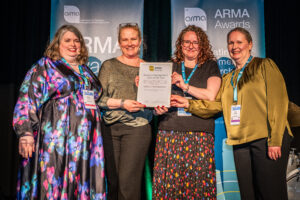
Durham University’s Research and Innovation Services (RIS) is a high-performing team enabling world-class research and knowledge exchange. Despite sector-wide challenges and reduced staffing, RIS delivered exceptional results in 2024/25: supporting £0.5bn in research grant applications, securing a 24% increase in awards, and meeting challenging research income targets. Highlights include, securing the university’s first Leverhulme Research Centre and winning Research England funding to support research-led business creation in their region. RIS also delivered extensive training and modernised processes, exemplifying resilience, collaboration, and innovation. This cohesive team has made a substantial, measurable impact on Durham’s research success.
Winner: Research Support Office, Bath Spa University
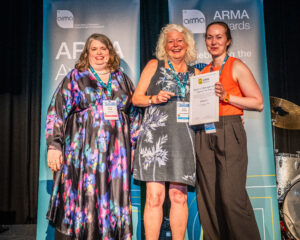 Bath Spa University’s Research Support Office exemplifies joined-up research management that transforms culture and strengthens institutional success. Managing 70–100 grants annually, they have lifted financial recovery by 20–30% and harmonised pre-award, post-award, governance, and impact for seamless delivery. They launched AHRC’s Impact Accelerator, delivered UKRI’s £2.9m StoryArcs, and secured Wellcome’s £1m We Are The People. They modernised integrity training, rolled out safeguarding, and boosted ethical GenAI confidence by 27%. As a small team achieving national influence, they set a benchmark for agile, inclusive, and replicable practice – meeting ARMA’s criteria for partnership, integration, and responsiveness.
Outstanding Contribution to Research Management
Winner: Anna Grey, University of Dundee

Anna Grey has made an outstanding and sustained contribution to research management in the UK, particularly through her leadership of REF-related professional practice. As founding champion of the ARMA REF Special Interest Group, Anna provided consistent, authoritative leadership for almost a decade, shaping professional understanding and capability across the sector. Beyond ARMA, she has played a critical role in the development and delivery of REF 2014, 2021 and 2029, combining deep operational expertise with constructive policy challenge. Her contribution has materially strengthened the standing, confidence and effectiveness of research managers across the UK.
Thank you to everyone who submitted a nomination and helped showcase the breadth and impact of work taking place across the research management sector. The standard was exceptionally high, making this year’s selection particularly competitive.
We look forward to continuing to celebrate the profession, with entries for the 2027 ARMA Awards opening in October.